The Missed Opportunity of Trains in the U.S. - Listening Worksheet
1. Listen to the podcast.
a. Before discussing the main idea, think back to your predictions.
- Did you hear any of the words you expected?
- Choose 3-5 words you heard and write simple sentences with them to show what you understood.
b. Answer the following questions:
- What is being compared?
- Which types of transportation were mentioned?
- Which ones seem more supported or popular in the U.S.?
- How do you know?
2. Listen again. Focus on the government’s role and the consequences.
a. Work with a partner.
You heard the phrases “divest from train travel” and “give highways a blank check.” Try to figure out what they mean. What was said before and after the phrase? What other words in the sentence helped you understand the meaning?
“Divest from train travel”:
- Clues from the sentence: ...
- Our guess: ...
“Give highways a blank check”:
- Clues from the sentence: ...
- Our guess: ...
Share your guesses with the class. Then, check: Were you close?
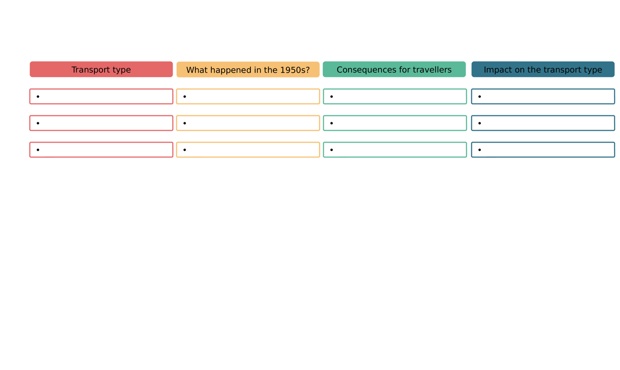
b. In pairs, discuss and use your notes to fill in the boxes in the table below with what happened to each type of transport. You can copy the table in your notebook, fill it in online or download it.
c. Share your ideas with the class.
- Were your ideas similar to other groups?
- What surprised you most in the podcast?
d. Listen for numbers and dates.
- What do they tell us about the the current situation?
- Write a short conclusion (2-3 sentences) using the numbers and the dates to explain what this tells you about the U.S. government’s current priorities in transportation, and whether they seem different from the past.
Source : https://lesmanuelslibres.region-academique-idf.frTélécharger le manuel : https://forge.apps.education.fr/drane-ile-de-france/les-manuels-libres/anglais-seconde ou directement le fichier ZIPSous réserve des droits de propriété intellectuelle de tiers, les contenus de ce site sont proposés dans le cadre du droit Français sous licence CC BY-NC-SA 4.0